KLIS FORTRESS
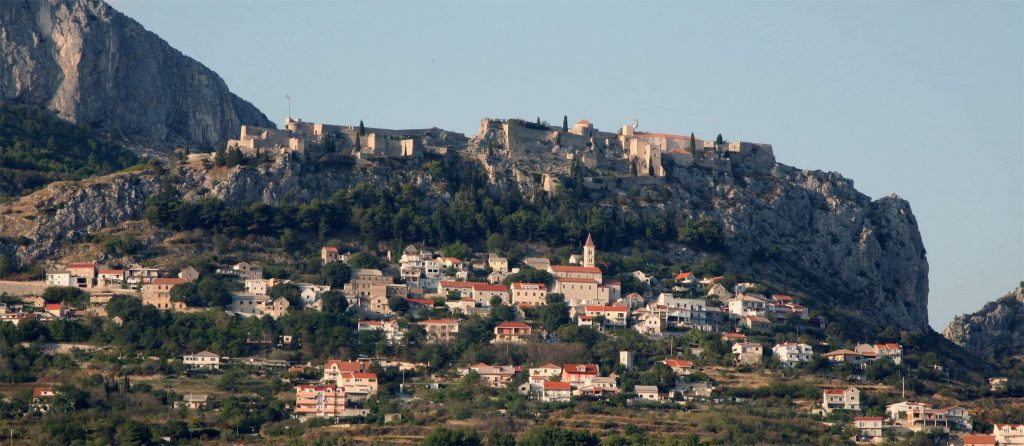
On the steep cliffs of a mountain pass between Kozjak and Mosorstands the Klis Fortress overlooking the sea on one side and the Dalmatian highlands on the other. It was built in an excellent strategic location enabling both military and commercial control over the whole Klis field and the area of Salona and Split. Given its importance, Klis was often named the key of Dalmatia and the heart of the medieval Kingdom of Croatia.
On the steep cliffs of a mountain pass between Kozjak and Mosorstands the Klis Fortress overlooking the sea on one side and the Dalmatian highlands on the other. It was built in an excellent strategic location enabling both military and commercial control over the whole Klis field and the area of Salona and Split. Given its importance, Klis was often named the key of Dalmatia and the heart of the medieval Kingdom of Croatia.
There is no doubt that the area was populated even in the following period with the tribe of the Dalmatae, one of the Illyric tribes, who were the first people that we were ableto identify. They populated the area between the Krka and Neretva river, and also the area along the Jadro river (today’s Solinčica). Illyric hillforts (gradine) were built on natural hills in order to defend themselves easily from the attackers. At the foot of the Klis Fortress the remains of a similar settlement have been found: the role of the settlement was to control the passage from Kozjakand Mosor. Along with Markezinagreda and a hillfort above Odž, which are located in the north on the hill of Kozjak.This hillfort controlled the access to the Illyric Salona and the mouth of the Jadro river. The role was later assumed by all the other hillforts in that location.
With the expansion of the Roman Empire, there was first a contact and then even a conflict between the local Illyric population and the conquerors from Lazio. After lasting wars, the Illyric revolts ended with the extinction of Bato uprising in 9 AD. In the period of the Late Roman Empire a Roman stronghold Kleisa was founded where military forces resided as an outpost of Salona, an antique capital of the Roman Dalmatia. With the Fall of the Roman Empire the area of Salona and the Klis Fortress were ruled by the Byzantine Empire and it would stay like that until the new conquerors from northeast arrived. As described by Constantine Porphyrogenitus in hisDe AministrandoImperi, the sentry above Salona was finally defeated in 614. Then, allegedly through deceit, the stronghold was stormed through by an Avar-Slavonic horde that would plunder and devastate Salona whose inhabitants found shelter behind the walls of the Diocletian’s Palace, the core of the today’s Split.
Padom Rimskog carstva, prostor Salone i utvrda Klis dolaze pod vlast Bizantskog carstva u čijim rukama će ostati do dolaska novih osvajača sa sjeveroistoka. Straža iznad Salone u konačnici je, kako navodi Konstantin Porfirogenet u svojem djelu De administrando imperii, pokleknula 614. godine. Tada je kroz utvrdu, navodno prevarom, prošla avarsko-slavenska horda koja će u nastavku pohoda opljačkati i razoriti Salonu čije će se stanovništvo skloniti iza zidina Dioklecijanove palače, jezgre današnjeg Splita.
In the next 200 years there are only scarce data about its history due to great turbulences during the period and the lack of literacy of the people who moved there. This is when the Croats arrived in this area and it is highly probable that it was from Klis that they first saw the Adriatic Sea since they are assumed to have taken the old Roman road leading from the Danube region across Bosnia to Salona. The next important moment in the history of the Klis Fortress is Charter of Duke Trpimir from 852 where it is mentioned that Klis is one of the seven estates of the duke. During the next seven centuries the fortress changed its name, and it was pivotal during the Tatar invasion in the Hungarian-Croatian Kingdom when it offered shelter to King Béla IV fleeing from the Horde.
Still, Klis gained its reputation in the Croatian history in the 15th century and onwards when it found itself on the border between three empires – the Ottoman Empire, the Republic of Venice and the Habsburg Monarchy. Back then Klis was home to the Uskoks, irregular soldiers whose name derives from “jump into” (“uskočiti” in Croatian) which is what they did – they would ambush the enemy territory, take loot and get back to their headquarters. The leader of the Uskoks of Klis was PetarKružić who with his men, for more than twenty years, defended the fortress from a much more powerful Ottoman army. However, given the fact that he had scarce help from the ruler of Klis, he could not resist for a long time, so in 1537 he was finally defeated by the Turks.
During the next 111 years Klis was under the Ottoman rule. In that period Venetians and the Uskoks tried to occupy it several times and in1596 they finally managed to do so. A hundred Croats led by the nobles from Splithad taken control of the fortress by surprise after which they were joined by other compatriots from the surroundings. Still, in the same year they suffered a counterattack by the Ottomans who with their larger army eventually forced the defenders to withdraw and leave the town.
The Klis Fortress played its last large role in a military sense during the Candian War between the Republic of Venice and the Ottoman Empire. Back then large battles were fought to win the control over the fortress, which, in the end, fell under the rule of the Venetian army where numerous Croats fought. From that moment on there would be no military activities under the walls of the Klis Fortress – it stayed in the Venetian possession until 1797 when the French took over the control over the fortress. With the fall of Napoleon, the fortress became part of the Habsburg Monarchy and once the monarchy was overthrown, it shared the destiny of other Croatian territories up until 1990 when the Croatian flag was hoisted there.
 English
  Croatian